
Shop Prep for Wood Dust: A Practical Beginner Guide to Cleaner, Safer CNC and Woodworking
Learn why wood dust matters, what OSHA and woodworking safety guidance say about health and fire risks, and the basic shop-prep steps—source capture, hose routing, housekeeping, and PPE—that hobby CNC users can start using this week.
Why dust control belongs in “shop prep,” not afterthought cleaning
If you run a CNC router, sander, or other woodworking tools at home, dust is not just a mess—it is a health and fire concern. OSHA’s woodworking eTool explains that wood dust exposure has long been associated with dermatitis, allergic and nonallergic respiratory effects, asthma, hypersensitivity pneumonitis, chronic bronchitis, and—for some hardwood exposures—nasal cancer risk discussed in occupational literature.
OSHA also notes that wood dust is emitted at high velocity by spinning tooling, and that the primary engineering control is local exhaust ventilation (LEV) that captures dust at or near the source. That is exactly why hose mounts, blast gates, and collector checks belong in your pre-job shop prep—not only in a Saturday deep clean.
What the health guidance actually says (in plain language)
OSHA’s chemical data summary for wood dust lists an OSHA permissible exposure limit (PEL) of 15 mg/m³ total dust and 5 mg/m³ respirable dust as an 8-hour time-weighted average for particulate not otherwise regulated (PNOR) references used for wood dust in that listing, while NIOSH recommends a much lower recommended exposure level of 1 mg/m³ total dust. ACGIH has published species-specific TLVs (for example western red cedar at 0.5 mg/m³ inhalable, and 1 mg/m³ inhalable for other species in the ACGIH notes summarized by OSHA).
You do not need to memorize every number to prepare a home shop well. The practical takeaway from OSHA’s woodworking dust guidance is simple: capture dust near the cutter, keep collection working, and do not treat settled dust as harmless clutter.
OSHA also warns that both skin and respiratory systems can become sensitized to wood dust, after which reactions can occur at lower exposures. If you feel ongoing irritation, asthma-like symptoms, or dermatitis from shop dust, that is a stop-and-reassess signal—not a badge of “getting used to it.”
Fire and explosion context (especially fine dust)
OSHA’s woodworking fire-and-explosion eTool notes that woodworking facilities are especially at risk because sawdust ignites and burns more easily than solid lumber, and that sanders, routers, and shapers produce large amounts of fine dust. Fine dust can accumulate on rafters and unexpected surfaces far from the machine.
OSHA’s prevention guidance emphasizes two pillars: exhaust ventilation as the principal engineering control, and good housekeeping as the primary work-practice control. Dust collection is best done at the point of operation when feasible, using well-designed hoods and ducts before dust reaches the operator’s breathing zone.
NFPA publishes NFPA 664, Standard for the Prevention of Fires and Explosions in Wood Processing and Woodworking Facilities, for facilities that process wood and generate combustible wood dust. Home hobby shops are not automatically industrial plants, but the same physical reality applies: fine dry dust plus ignition sources is a bad combination. Treat dust piles and clogged collectors as a safety issue, not only a cleanup chore.
A beginner shop-prep routine before you cut
1) Confirm your dust collector or shop vac is empty enough to pull air. A full drum or clogged filter quietly ruins extraction. 2) Connect the hose to the CNC dust shoe or port and support the hose so it cannot snag the gantry—hose management is part of prep, not an afterthought mid-cut. 3) Turn extraction on before the spindle starts and listen/feel for airflow. 4) Keep the table clear of chips from the last job so new dust does not ride around on loose debris.
OSHA recommends locating exhaust hoods as close as possible to the emission source and maintaining duct velocity in the ranges discussed in their woodworking dust eTool (they cite a minimum of roughly 2,500 to 4,000 feet per minute in that guidance for carrying mixed wood waste). You may not measure FPM at home, but you can still prep for success: short hose runs, fewer sharp bends, closed unused ports, and no crushed flex hose.
After the job, vacuum settled dust instead of blasting it into the air with compressed air. OSHA’s fire/explosion guidance stresses preventing buildup and cleaning areas where fine dust migrates, including out-of-the-way surfaces.
PPE is a backup, not the whole plan
Engineering controls (source capture) come first. Eye protection and hearing protection still belong in a CNC/woodworking pre-start habit. For dusty operations where extraction cannot fully control exposure, a properly selected particulate respirator can be an additional control—but it does not replace a working collector.
UK HSE woodworking guidance for routers likewise emphasizes that routing produces high dust levels and that wood dust can cause dermatitis and asthma, with hardwood dusts also linked to nasal cancer risk in that guidance series. Their control approach pairs engineering control with respiratory protective equipment when needed. The beginner lesson is the same: plan extraction first, then PPE.
Tools that make dust prep easier in a CNC corner
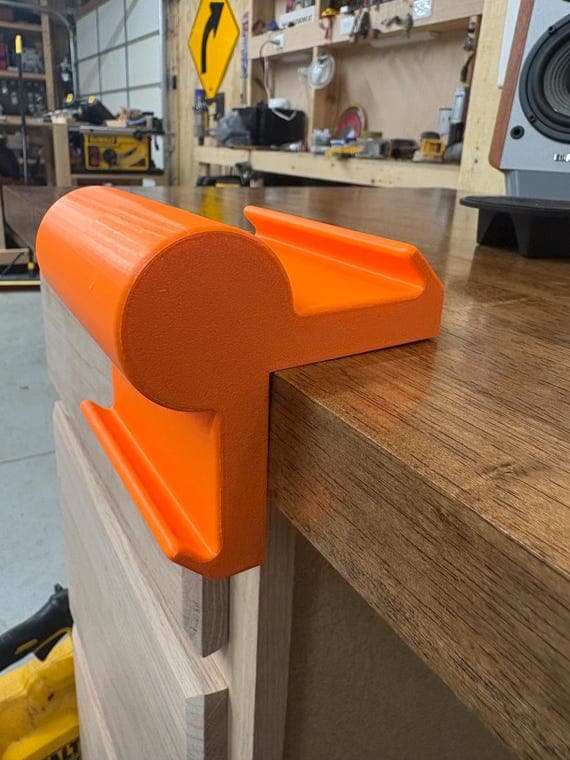
A secure dust-hose mount keeps flex hose off the spindle cable chain and out of the cut path. Workholding that does not force awkward setups also helps you keep the dust shoe closer to the stock. If you are building out a Shapeoko-style workstation, browse Kolton Kraft CNC Tools for hose mounts, clamps, and related shop helpers designed for real workholding—not decoration.
Sources
Claims in this guide are grounded in the references below. Always check the live primary source for the latest wording.
Related products
Parts from the Kolton Kraft shop that pair with this guide.
Related YouTube videos
Helpful public videos from other creators and educational channels. These are not Kolton Kraft videos— we link them because they match this topic. Opening a link takes you to YouTube.
- How to make a dust collector with a wet/dry vacI Like To Make Stuff · Watch on YouTube
- How to use the Shapeoko Pro XXL (includes dust shoe & probing workflow)MakeHaven · Watch on YouTube
Kolton Kraft on YouTube
Shop builds and project videos from this channel.
Visit the Kolton Kraft channel